
Discover Furuya Korin, the Japanese artist and designer who reimagined traditional Japanese decorative art through elegant patterns, stylized flowers, and nature-inspired designs in the early twentieth century.

Imagine a branch of plum blossoms transformed into a flowing pattern, waves reduced to graceful curves, or leaves and flowers arranged in a composition that feels both timeless and modern.
These are the kinds of designs that make Japanese decorative art so fascinating. Rather than simply reproducing nature, artists transform its shapes, rhythms, and colors into patterns that can be used in textiles, ceramics, lacquerware, and countless other objects.
One artist who helped bring this tradition into the modern era was Furuya Korin.
Active during Japan’s Meiji period, Furuya Korin drew inspiration from centuries of Japanese artistic tradition while creating designs suited to a changing world. His work demonstrates how traditional motifs can be reimagined without losing their distinctive character.
But who was Furuya Korin? What is the connection between his art and the famous Rinpa tradition? And why do his designs continue to appeal to people who love Japanese art and design today?
Let’s explore the life and work of this remarkable artist.
Who Was Furuya Korin?
Furuya Korin (古谷紅麟, 1875–1910) was a Japanese painter, illustrator, and designer who worked during the Meiji period (1868–1912).
He was born in Shiga Prefecture, near Kyoto, a region with deep connections to Japanese artistic and cultural traditions.
Korin studied with several artists, including Suzuki Mannen and Asai Chu. One of his most important teachers was Kamisaka Sekka, a leading figure in the revival and development of Rinpa-inspired art during the Meiji period.
Through this training, Korin became familiar with a tradition that emphasized bold compositions, decorative patterns, stylized natural forms, and expressive uses of color.
He went on to create paintings, illustrations, and design books that explored the possibilities of Japanese decorative art.
Although his life was relatively short, ending in 1910 at the age of thirty-four or thirty-five, depending on how his age is counted, his work contributed to the continued development of Japanese design at a time when the country was undergoing major cultural and social changes.
Today, he is particularly remembered for his beautifully illustrated pattern books, which preserve a wealth of decorative ideas inspired by nature and traditional Japanese aesthetics.
What Is the Rinpa Tradition?
To understand Furuya Korin’s work, it helps to learn about Rinpa (琳派), one of Japan’s most distinctive artistic traditions.
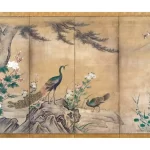
Rinpa developed in Kyoto during the early seventeenth century and became known for its decorative approach to painting and design. Artists associated with the tradition created works featuring flowers, trees, birds, flowing water, and other subjects drawn from nature and classical Japanese culture.
Rather than always depicting subjects in a strictly realistic way, Rinpa artists often simplified or stylized natural forms. They used bold shapes, carefully balanced compositions, decorative patterns, and striking color combinations to create images that were visually powerful.
The tradition influenced a wide range of artistic fields, including painting, textiles, ceramics, and lacquerware.
Two important historical figures associated with Rinpa are Tawaraya Sotatsu and Ogata Korin. Their work helped establish the distinctive visual language that later artists continued to study and reinterpret.
By the late nineteenth and early twentieth centuries, artists such as Kamisaka Sekka were helping to renew interest in Rinpa while adapting its aesthetics to the modern era.
Furuya Korin studied with Sekka and became part of this revival.
His designs demonstrate how the traditional vocabulary of Japanese art could be used to create fresh compositions for a new generation.
Why Is Furuya Korin’s Name Connected to Ogata Korin?
One of the most interesting details about Furuya Korin is his artistic name.
He adopted the name Korin in homage to Ogata Korin (1658–1716), the celebrated Kyoto artist whose work became central to the Rinpa tradition.
Although the two artists lived nearly two centuries apart, their connection reflects the importance of artistic lineage in Japanese culture.
Artists frequently learned from earlier masters, studied their techniques, and developed their own interpretations of established traditions. An artistic name could express admiration for a predecessor while signaling an intention to continue or reinterpret that person’s legacy.
Furuya Korin’s name therefore offers a clue to his artistic ambitions. He was working within a tradition that he admired, but he was also adapting it to the world around him.
It is important to distinguish the two artists, however. Furuya Korin and Ogata Korin were different people who lived in different centuries.
Ogata Korin is famous for his paintings and decorative masterpieces from the Edo period. Furuya Korin is particularly associated with illustrated design books and the modern revival of Japanese decorative art during the Meiji period.
Understanding this distinction makes it easier to appreciate how Japanese artistic traditions evolved over time.
What Makes Furuya Korin’s Designs So Special?
Furuya Korin’s work is particularly appealing to people who love patterns and decorative design.
His compositions often transform familiar natural subjects into stylized arrangements that feel carefully balanced and full of movement.
Several characteristics help explain their enduring appeal.
1. Inspiration from Nature
Flowers, leaves, trees, vines, and other natural forms are recurring subjects in Japanese decorative art.
Furuya Korin drew on this rich visual vocabulary, arranging natural motifs in ways that emphasize their shapes, textures, and relationships to one another.
A flowering branch might become an elegant sweeping line. Leaves can form repeating patterns, while blossoms provide contrasting shapes and colors.
Rather than simply copying nature, these designs interpret it.
This approach allows a familiar plant or flower to become something both recognizable and abstract. The viewer can appreciate the original subject while also enjoying the rhythm and balance of the composition.
Nature becomes a source of endless possibilities for artistic expression.
2. The Beauty of Stylized Patterns
One of the pleasures of Japanese decorative art is discovering how much can be communicated through simplified forms.
A few carefully arranged lines can suggest flowing water. Repeated shapes can create the impression of movement, while a combination of organic forms and geometric elements can give a design a sense of order.
Furuya Korin’s design books demonstrate this relationship between natural imagery and decorative pattern.
His work belongs to a broader tradition in which designs were created not only to be admired as pictures but also to inspire practical applications in textiles and other decorative arts.
This makes his work particularly interesting from a modern design perspective.
The same principles that make a pattern beautiful on a page can also make it effective on fabric, wallpaper, stationery, or a decorative object.
3. A Balance Between Tradition and Modernity
Furuya Korin worked during a period when Japan was experiencing rapid modernization.
The Meiji era brought significant changes to Japanese society, industry, education, and international cultural exchange. Artists and designers were exploring new materials and ideas while reconsidering the value of traditional artistic practices.
In this environment, Japanese decorative design developed in conversation with both historical traditions and contemporary influences.
Rinpa-inspired forms continued to evolve, while designers also encountered new approaches to composition and ornament.
Furuya Korin’s work reflects this creative environment. His designs preserve the recognizable characteristics of traditional Japanese decorative art while presenting them in a format that suited the needs and interests of his time.
This combination helps explain why his work can feel surprisingly contemporary.

Kōrin moyō: A Beautiful Collection of Japanese Patterns
One of Furuya Korin’s best-known works is Kōrin moyō (光琳模様), a two-volume illustrated design book published in 1907.
The title can be understood as referring to patterns in the style of Korin.
The book was published by Unsōdō, a Kyoto publisher known for producing beautifully illustrated Japanese art and design books.
Created using woodblock printing, Kōrin moyō brings together decorative designs inspired by the Rinpa tradition. Its pages demonstrate how familiar natural subjects can be transformed into carefully composed arrangements.
Among the motifs represented in the book are plants, flowers, and other elements drawn from the natural world.
Some compositions place simpler patterns alongside more elaborate scenes, creating a visual relationship between different levels of detail. The arrangement of each page encourages the viewer to compare shapes, notice repeated motifs, and appreciate the balance between individual elements.
The book is valuable not only as an example of Furuya Korin’s work but also as a record of the design culture of early twentieth-century Japan.
Today, surviving copies can be found in major collections, including the Smithsonian’s National Museum of Asian Art.
For anyone interested in Japanese patterns, Kōrin moyō offers a fascinating glimpse into the way artists organized and presented decorative ideas more than a century ago.
Beyond Patterns: Furuya Korin as a Designer
Although pattern books are central to his reputation today, Furuya Korin’s artistic interests were broader.
His work included illustrated books and designs connected with Japanese decorative arts and traditional culture.
One example is Sixteen Illustrations of Ancient Ceremonial Displays, published in 1903 and now in the collection of The Metropolitan Museum of Art in New York.
The book documents decorative arrangements associated with formal occasions in elite Japanese residences. Its illustrations preserve details of a traditional visual culture at a time when Japan was rapidly changing.
Works such as this show how illustrated books could serve several purposes at once. They could preserve historical knowledge, provide inspiration for artisans, and present decorative ideas to readers interested in art and design.
For Furuya Korin, the printed page was not merely a place to display an image. It was also a way to organize, share, and preserve a visual vocabulary.
His books allow us to see how Japanese design traditions were documented and reinterpreted during the Meiji era.
Why Furuya Korin’s Art Still Inspires Modern Design
More than a century after his death, Furuya Korin’s work remains relevant to anyone interested in Japanese decorative art.
One reason is the versatility of the patterns themselves.
Nature-inspired motifs can be adapted to many different materials and settings. A stylized flower can decorate a textile, while flowing lines and repeated shapes can inspire everything from packaging to interior design.
Another reason is the balance between simplicity and complexity found in traditional Japanese design.
A successful pattern does not necessarily need an abundance of detail. Sometimes a few well-chosen shapes, repeated with care, can create a design that feels harmonious and complete.
Furuya Korin’s work invites us to appreciate these principles and to recognize the thought behind decorative art that might otherwise be taken for granted.
His designs also remind us that tradition is not static. Artistic styles survive because each generation finds new ways to interpret them.
The Rinpa tradition that inspired Furuya Korin had already evolved over centuries before he began his career. Through his paintings and illustrated books, he helped carry that visual language into the modern era.
For contemporary admirers of Japanese art, his work offers both historical insight and lasting inspiration.
Discover the Beauty of Furuya Korin’s Art
Furuya Korin’s designs celebrate the beauty of nature through stylized forms, elegant patterns, and carefully balanced compositions.
His work connects the rich history of Japanese decorative art with the creative energy of the Meiji period, showing how traditional artistic ideas can continue to evolve.
From the intricate motifs of Kōrin moyō to his illustrated books documenting Japanese decorative culture, his work offers a window into a world where art and design were closely connected.
At Cocolo Color Design, we celebrate Japanese art and the stories behind the artists who shaped its many traditions.
Whether you are drawn to botanical motifs, traditional Japanese patterns, or the elegant simplicity of decorative design, Furuya Korin offers a wonderful starting point for further exploration.
Continue exploring Japanese art with Cocolo Color Design.
Further Reading
If you would like to learn more about Furuya Korin and explore examples of his original work, these museum collections and specialist resources are excellent places to start.
- The Metropolitan Museum of Art — Sixteen Illustrations of Ancient Ceremonial Displays
Explore an illustrated book by Furuya Korin that documents decorative arrangements associated with traditional Japanese ceremonial culture. - Smithsonian National Museum of Asian Art — Kōrin moyō
Discover the two-volume, woodblock-printed design book published in 1907 and learn more about its place in Japanese decorative art. - The Arthur Tress Collection of Japanese Illustrated Books — Furuya Korin, Kōrin moyō
Explore illustrated pages from Kōrin moyō and learn how Furuya Korin combined traditional Rinpa motifs with carefully arranged decorative patterns.
At Cocolo Color Design, we believe that understanding the artists and traditions behind Japanese art makes each work more meaningful. We invite you to continue exploring the beauty of Japanese design and discover artwork that inspires you.